First Time on a Jet Ski: What to Wear, Ages, Nerves and Staying Safe
Never ridden a jet ski? You’re the rule, not the exception. On any given morning in Puerto Colón, most of the people wheeling a ski off the pontoon have never touched one before — and twenty minutes later they’re grinning across open Atlantic at 50 km/h. The machines are built for beginners, the guides brief you until you’re comfortable, and there’s no exam, no paperwork beyond a waiver, and no licence needed for guided rides or circuits in Spain.
This page walks through exactly what happens from the moment you arrive at the marina, answers the question everyone quietly worries about (is it hard? — honestly, no), and covers the practical stuff: what to wear, who can and can’t ride, what happens if you fall off, and how to be a good passenger. If you want the full picture of routes and prices first, start with the main Costa Adeje jet ski guide, then come back here to settle the nerves.
What actually happens, step by step
Every operator in Puerto Colón runs roughly the same sequence, whether you’ve booked a 20-minute circuit or a two-hour safari. Nobody hands you keys and points at the horizon.
| Stage | What happens | Roughly how long |
|---|---|---|
| Check-in | Show ID, sign the waiver, pay any balance, stash your things in a locker | 5–10 min |
| Kit up | Life jacket fitted and clipped; wetsuit offered in the cooler months | 5 min |
| Safety briefing | Controls, hand signals, the ride zone, what to do if you fall in | ~10 min |
| Kill cord clipped | The guide attaches the safety lanyard to your wrist or jacket | 1 min |
| Practice minutes | Slow, no-wake riding inside or just outside the harbour while the guide watches | 5–10 min |
| The ride | Follow-the-leader along the coast, with speed opening up as your confidence does | 20 min – 3 h |
The briefing is the part that matters. A good one — and the Puerto Colón operators run tight ones, because their insurance depends on it — covers how to start, accelerate, turn and stop, where you’re allowed to ride, the hand signals the guide will use, and exactly what to do if you end up in the water. Ask anything. Guides would far rather answer a “stupid” question on the pontoon than shout the answer across open water later.
Then come the practice minutes, which are the real confidence trick. You idle out of the marina at walking pace — there’s a strict no-wake zone anyway — and get a few minutes of gentle throttle in calm water while the guide checks everyone can steer a straight line and stop. Only then does the group head out and the speed build. By the time you’re doing anything fast, the controls already feel familiar.
Is it hard? Honestly: no
A modern jet ski has two controls you care about: a throttle lever under your right thumb and handlebars. That’s it. No gears, no clutch, no foot pedals. Squeeze the throttle to go, ease off to slow down, turn the bars to steer. If you can ride a bicycle — arguably even if you can’t — you can ride a jet ski at beginner pace within minutes.
The one genuinely counter-intuitive thing, and the single most useful fact on this page, is how stopping works. A jet ski has no brakes in the car sense — a few newer models add an electronic brake lever, but the briefing teaches you to ride as if yours doesn’t. You stop by releasing the throttle: the jet stops pushing, water drag takes over, and the ski coasts to a halt over a few boat-lengths — quickly at low speed, longer from full tilt. The knock-on effect is that steering needs throttle. The ski turns by vectoring its jet of water, so if you release the throttle completely mid-panic, you also lose most of your steering. The briefing drills this: see an obstacle, keep a little throttle on and steer around it, rather than chopping the power and drifting straight at it. It feels odd for about five minutes, then becomes instinct.
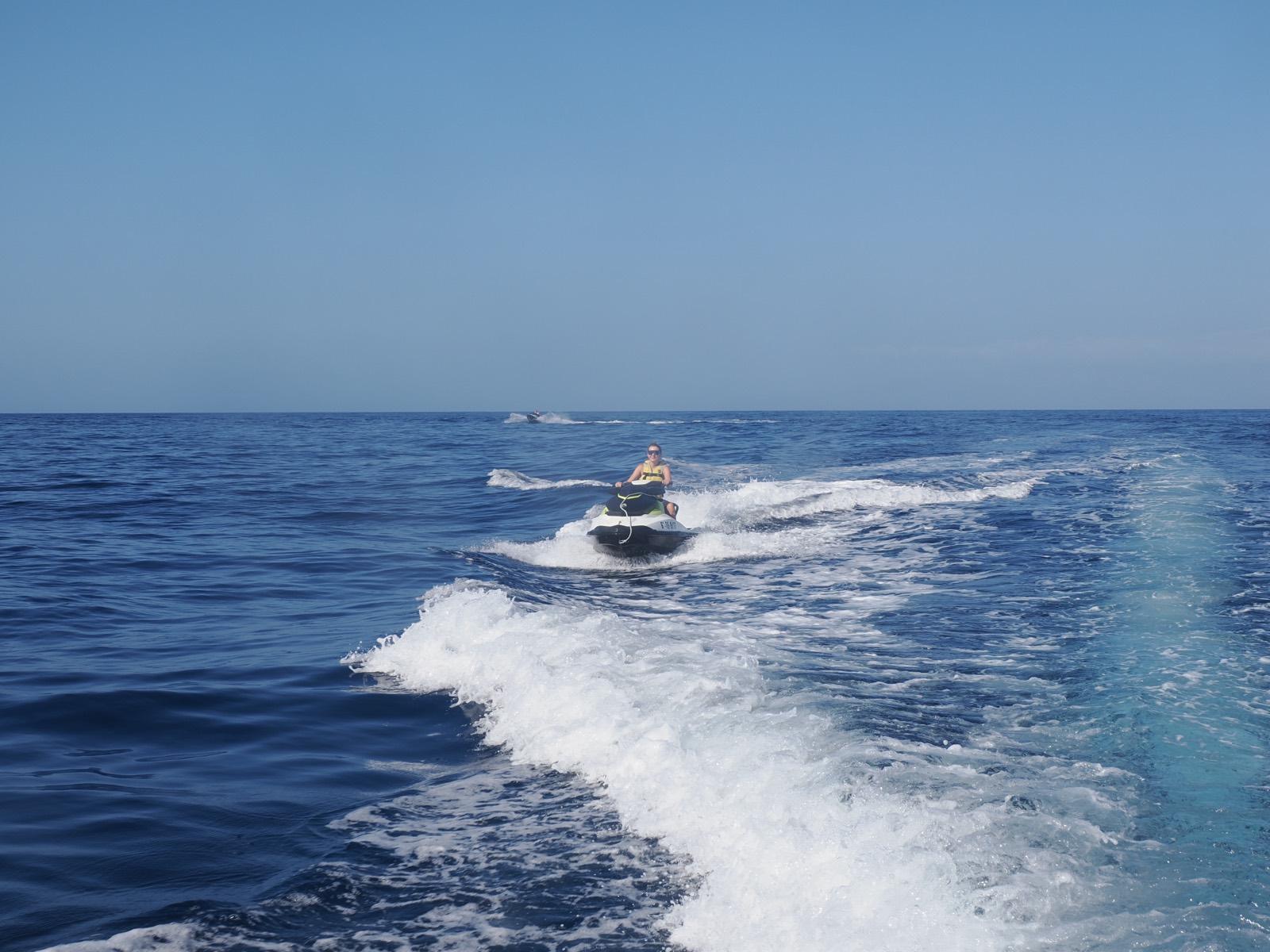 Open water off Costa Adeje — this is where the guide lets the speed off the leash.
Everything else is forgiving. The skis are wide, stable and very hard to flip at sensible speeds. Sit (all the Puerto Colón tour skis are sit-down models, not stand-ups), keep your feet in the footwells, look where you want to go, and the machine does the rest. First-timers who were white-knuckled at the briefing are usually asking for more time by the halfway point.
What to wear (and what to leave in the locker)
Short version: swimwear, sunscreen, and things that can’t fly off. The operator supplies the safety kit.
| Item | Summer (Jun–Oct) | Winter (Nov–May) |
|---|---|---|
| Base layer | Swimwear — you will get spray | Swimwear plus the wetsuit operators offer when it’s cooler; water is 18–21°C |
| Life jacket | Provided and mandatory, fitted by staff | Same |
| Feet | Barefoot on the ski, or secure water shoes/strap-on sandals — never flip-flops | Same |
| Eyes | Sunglasses only with a retainer strap; the spray and glare are real | Same |
| Sun | Waterproof SPF 50 on face, neck, tops of thighs and feet — the reflection off the water adds meaningfully to the dose | Still SPF 30+; Tenerife sun bites year-round |
| Everything else | Locker | Locker |
The sea off Costa Adeje sits between 18 and 24°C through the year, so summer riders are comfortable in just swimwear, and even in February a wetsuit turns the ride from bracing to pleasant. Operators keep wetsuits on hand in the cooler months — ask when you book if you run cold.
Two rules catch people out. First, loose phones don’t come on the water — a dropped phone is gone forever in 20-plus metres of Atlantic, so most operators ban them outright and the rest allow one only in a secured waterproof floating case. Leave it in the lockers provided and buy the photo package (typically €10–30) shot by the guide instead. Second, unsecured anything — caps, loose sunglasses, GoPros without a proper mount — tends to be donated to the ocean in the first hard turn. If it isn’t strapped to you, leave it ashore.
Ages, health and who can’t ride
The rules below are consistent across the Costa Adeje operators, with small variations — one runs a 160 kg combined weight limit, another 180 kg, and minimum passenger ages float between about 7 and 10. The table shows the common ground; the operator’s own terms are final.
| Rule | The standard |
|---|---|
| Drive solo | 16+, with a parent or guardian signing consent for under-18s |
| Drive with a passenger | 18+ |
| Ride as passenger | From roughly 7–8 years old and at least 1.30 m tall, with an adult driving |
| Combined weight | Around 160–220 kg per ski depending on operator and model |
| Pregnancy | Not permitted — the impacts through the seat are the issue, not the speed |
| Serious back, neck or heart conditions | Not recommended; talk to the operator honestly before booking |
| Non-swimmers | Varies — some operators take you (the life jacket does the floating), others expect basic swimming ability; confirm when booking and always tell your guide |
| Alcohol | Riders under the influence are refused, no refund; it’s also illegal |
The pregnancy and back-problem rules aren’t operators being over-cautious. Even moderate chop turns into repeated vertical impacts through the seat at speed, which is exactly the loading a pregnancy or a fragile spine doesn’t want. If you’re borderline — an old injury, a dodgy disc — mention it when booking; guides can put you at the calm back of the group and keep the pace gentler, but they need to know.
The alcohol line is absolute. A lunchtime beer before a 3 pm ride will get you turned away at check-in, and rightly so: you’re piloting a 100-plus-horsepower machine in shared water. Save the celebration cerveza for the marina bars afterwards.
Falling off: what actually happens
The fear looms far larger than the reality. On guided rides, falls are rare — the pace is controlled, the skis are stable, and guides watch for over-confidence — but here’s the full sequence if it happens to you:
- You come off, the engine dies instantly. The kill cord — a coiled lanyard clipped between you and the ski’s cut-off switch — pulls free as you separate and stops the engine dead. The ski doesn’t carry on without you; it bobs a few metres away, waiting. This is standard kit on every rental ski, and the RYA treats the kill cord as non-negotiable safety equipment for exactly this reason.
- You float. The life jacket is doing its one job. Even non-swimmers pop straight to the surface. The water’s 18–24°C — a surprise, not a shock.
- You reboard from the back. Swim to the stern, grab the handle above the boarding step, and haul yourself up the way you’d exit a pool. It takes more arm than grace. If two of you are aboard, the lighter person boards second while the heavier one balances the ski.
- Help is already coming. Your guide will be alongside within moments — one operator’s line is that the safety boat is “there within seconds”, and on a follow-the-leader ride that’s about right.
Reclip the kill cord, restart with the button, and you’re moving again. Total drama: about ninety seconds and a story for dinner.
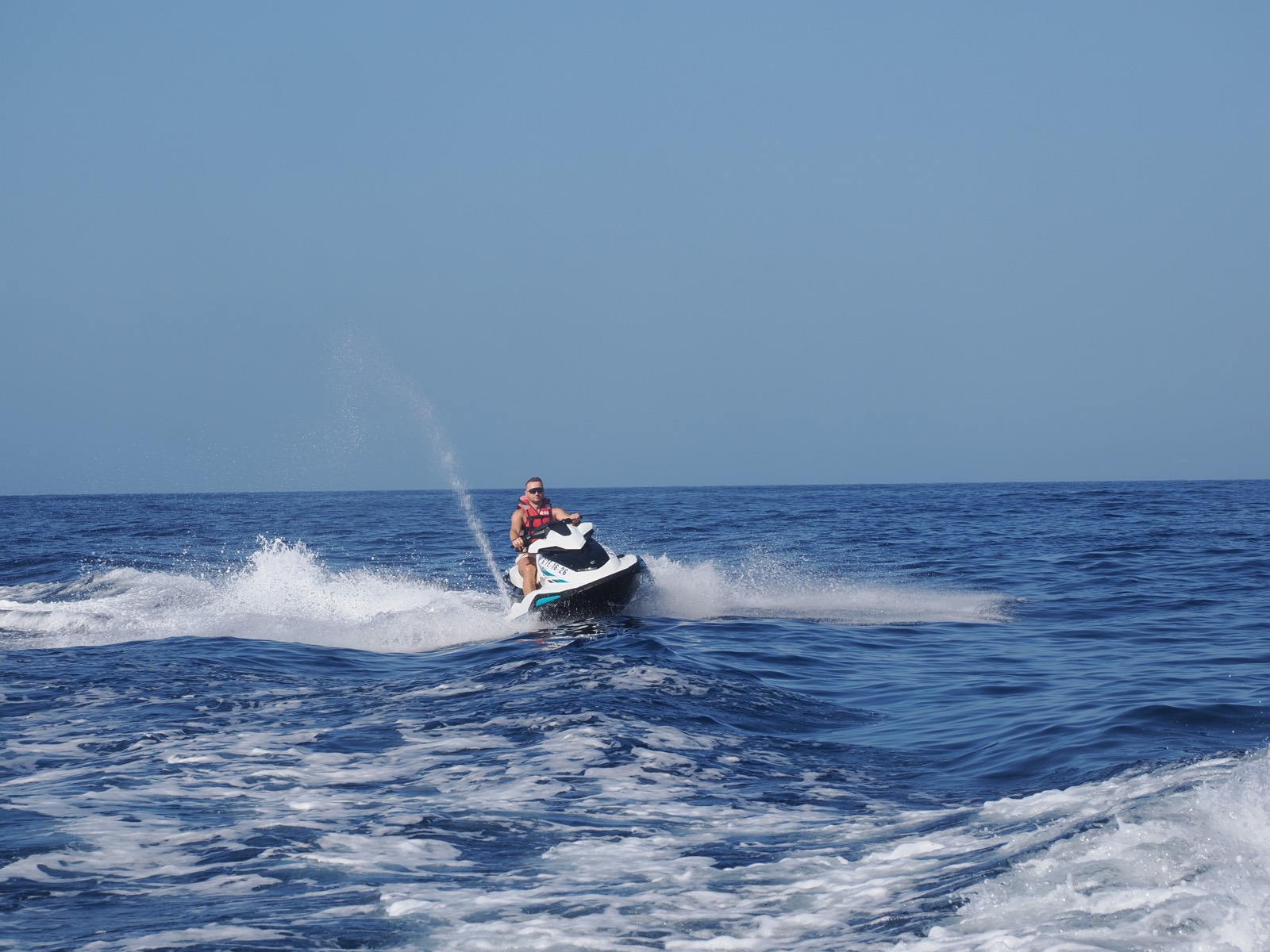 Lean, look through the turn, keep a little throttle on — this is the fun the briefing is buying you.
Riding pillion: how to be a good passenger
Two-up riding is how most families and couples do it — one licence-free driver aged 18+, one passenger holding on behind. Passengers have an easier job than drivers, but doing it well makes the ride faster, smoother and drier for both of you:
- Hold the driver’s waist or the seat strap, whichever the briefing recommends — a firm hold, not a death grip.
- Lean with the driver, not against them. The instinct in a turn is to stay upright; fight it. Think motorbike pillion: you and the driver tilt as one unit and the ski carves cleanly. Lean the wrong way and the turn gets wallowy and wet.
- Feet stay in the footwells the whole time — they’re your stability.
- Look over the driver’s inside shoulder in turns. It keeps your weight where it should be and you see the fun coming.
- Agree a tap signal before you set off — one tap for “slower”, two for “all good, faster”. Shouting over wind and engine doesn’t work.
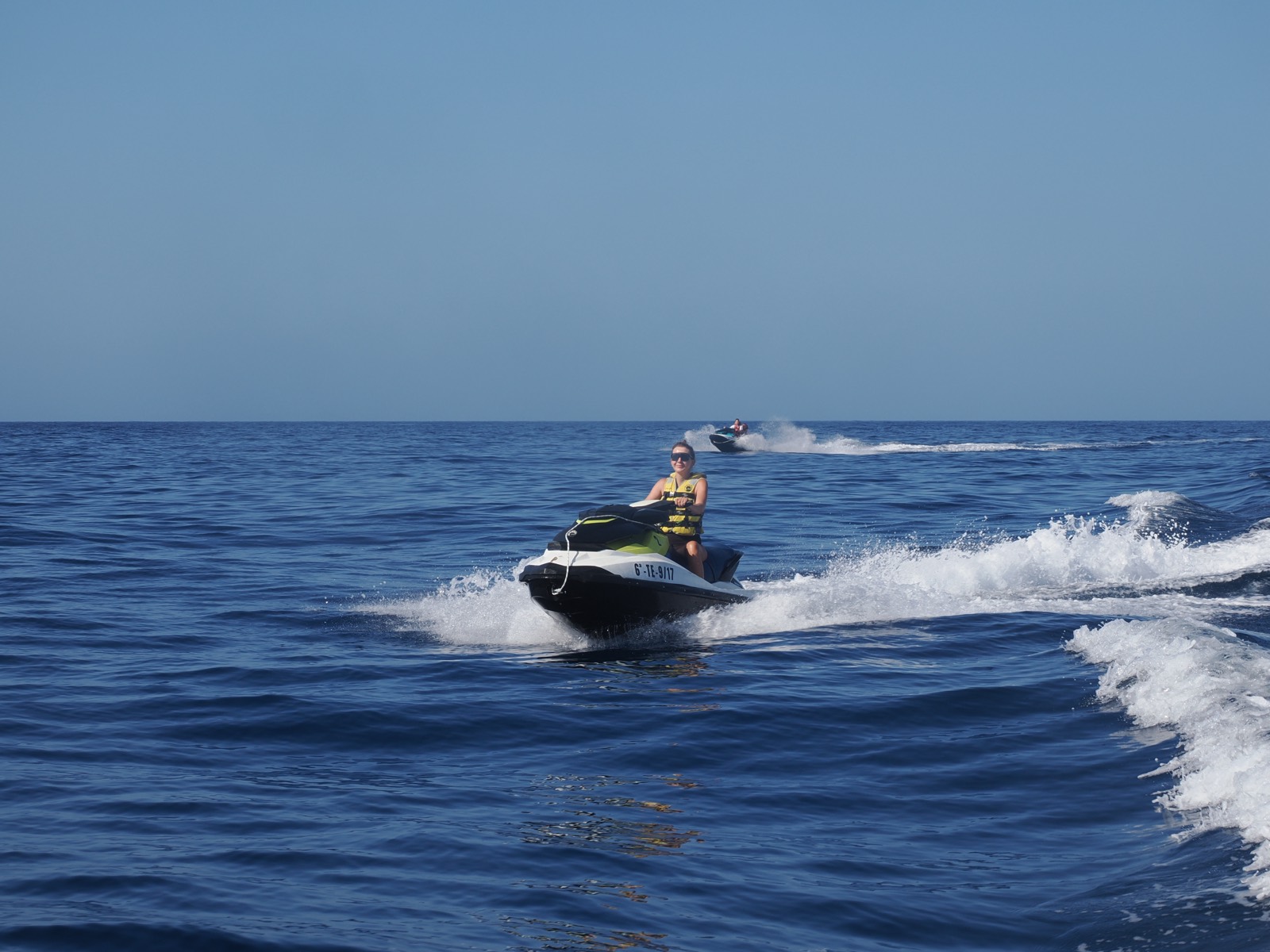 Convoy formation on a guided run — passengers who lean with their drivers are the ones still dry at this point.
Sea sickness: almost never a problem
Genuine question, easy answer: jet skis are about the most seasickness-proof craft on the water. Motion sickness comes from your inner ear disagreeing with your eyes — a problem on enclosed boats where the horizon disappears. On a ski you’re in open air, eyes locked on the horizon, actively steering, with wind and spray on your face. Every one of those factors suppresses nausea. Even people who turn green on the Los Cristianos ferry are generally fine.
If you’re properly susceptible, book a morning slot — the sea off Costa Adeje is at its calmest before about 1 pm — take a non-drowsy tablet an hour before if you’d take one anyway, and skip the full English right before launch. A 1-hour safari in morning conditions is a smoother introduction than an afternoon slot when the wind is up.
Respect the water: wildlife and everyone else
The stretch between Costa Adeje and La Caleta is shared water — swimmers, kayaks, paddleboarders, dive boats, and some genuinely special wildlife. Guided groups stay outside the buoyed swimming zones and keep speeds right down near the harbour and shore; your job is simply to hold your position in the group and not freelance.
On wildlife, be a sceptical booker. These waters do hold dolphins and pilot whales, and seeing them from a ski is magic — but it’s luck, not a product. Spanish law (Royal Decree 1727/2007) sets a 60-metre exclusion zone around cetaceans: no approaching closer, and if animals surface nearby the engine goes to neutral or off until they’ve moved away. Reputable guides follow this properly, which means the whale-watching catamarans with hydrophones and viewing decks are the better dolphin bet. And treat any listing promising turtles at El Puertito with suspicion — the resident green turtles that made the bay famous are gone, largely because of the constant attention. Ride for the riding; treat any fin on the horizon as a bonus.
Ten quick tips for your first ride
- Book a morning slot — calmer sea, softer light, easier first ride.
- Ask questions at the briefing — the pontoon is the place, not open water.
- Remember: no throttle, no steering. Steer around trouble with power on; don’t chop the throttle and drift.
- Grip with your knees, not just your arms — you’ll ache less tomorrow.
- Look where you want to go, not at the thing you’re avoiding. The ski follows your eyes.
- Cross wakes at a slight angle with knees bent — let your legs absorb the hop.
- Strap your sunglasses or leave them in the locker.
- Waterproof sunscreen before you kit up, including thighs and feet.
- Tell the guide anything relevant — can’t swim, dodgy back, nervous passenger. They adjust; that’s the job.
- Relax your grip. White knuckles cause more wobbles than waves do. The ski wants to run straight — let it.
If one ride hooks you — it usually does — the jet ski hire guide covers longer sessions and how the per-ski pricing works when you split it two-up, from around €60 for a 20-minute circuit to €90–120 for a one-hour safari.
Frequently asked questions
Do I need any experience or a licence for my first jet ski ride?
No experience and no licence. Guided tours and buoyed circuits in Spain are exempt from licence requirements (Royal Decree 259/2002) — the law instead requires the operator to brief you first and supervise the ride. You need ID, a signed waiver (with parental consent if you’re 16 or 17), and about ten minutes of attention on the pontoon. Solo hire away from a guide is a different legal situation, covered in the Spanish licence guide.
Is jet skiing scary for beginners?
The anticipation is scarier than the ride. You start at walking pace inside the harbour, practise under the guide’s eye, and only build speed when you’re steering confidently. The skis are stable, there are no gears or brakes to manage, and you control every km/h with your own thumb. Most nervous first-timers describe the fear evaporating within the first five minutes — and then ask for a longer tour next time.
What happens if I fall off the jet ski?
The kill cord pulls out as you separate, cutting the engine instantly, so the ski stops beside you rather than carrying on. Your life jacket does the floating — even weak swimmers pop straight to the surface — and you climb back on at the stern using the boarding handle. The guide is alongside within moments. Falls are rare on guided rides at beginner pace, and the water off Costa Adeje is 18–24°C year-round, so there’s no cold-shock factor.
Can my child come on a jet ski in Costa Adeje?
As a passenger, yes — most operators take children from roughly 7–8 years old (a few say 10) provided they’re at least 1.30 m tall and ride with an adult driver aged 18 or over. To drive, the minimum is 16 with a parent or guardian’s signed consent, and 16–17-year-olds can’t carry passengers. Combined weight per ski is capped at roughly 160–220 kg depending on the operator.
Can I jet ski while pregnant or with a bad back?
Pregnant riders are not permitted, as driver or passenger — the repeated impacts through the seat in chop are the problem, and every Costa Adeje operator applies the rule. Serious back, neck or heart conditions are strongly advised against for the same reason. If you have an old injury and aren’t sure, contact the operator before booking; they’ll give an honest answer and can sometimes accommodate you on a slower, calmer format.
What should I wear on a jet ski in Tenerife?
Swimwear under the provided life jacket, waterproof sunscreen, and either bare feet or secure water shoes — never flip-flops. Sunglasses need a retainer strap or they’re going overboard. From roughly November to May, take the wetsuit operators offer; the water drops to 18–21°C and the wind chill at speed is real. Everything else — phone included, unless yours is in an operator-approved waterproof floating case — goes in the lockers provided.
Will I get seasick on a jet ski?
Very unlikely, even if boats normally get you. Seasickness needs a disagreement between eyes and inner ear, and a jet ski removes it: you’re in open air, watching the horizon, actively steering, with constant wind on your face. Riders who struggle on ferries and catamarans are routinely fine on skis. If you’re especially prone, book a calm morning slot and eat light beforehand — that’s usually all it takes.